

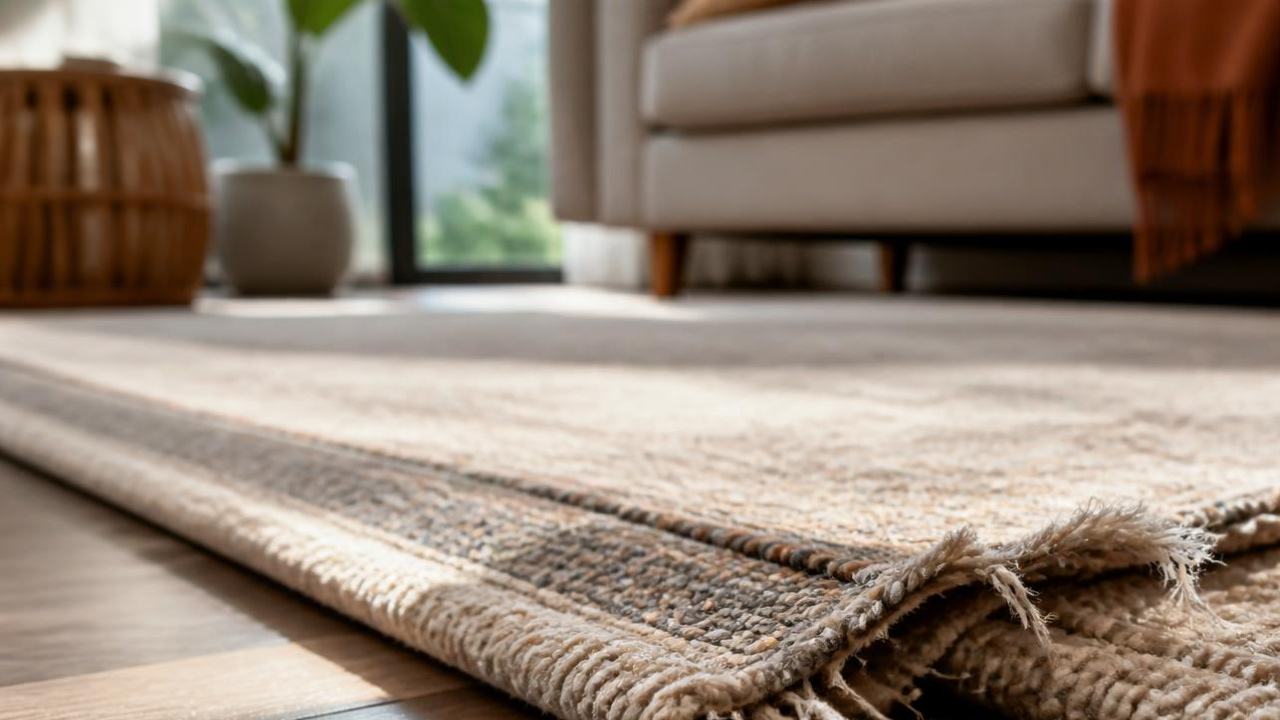
A carpet tuft is held in place by nothing more than the grip of the backing around its base, and there is a standardized laboratory test built to measure that grip. It comes from ASTM International, the organization that writes testing standards for materials, and it is called ASTM D1335, the tuft-bind test: it clamps one tuft, pulls until the tuft comes free, and records the pounds of force it took. A rug or carpet frays at the edge for one plain reason. Cut the backing to size, and the yarn along that fresh edge has almost none of that grip left holding it in. That's the whole cause. Everything people try to keep a rug from fraying either puts that grip back or works around its absence, and knowing which is which is the difference between a repair that lasts and one that peels off in a month.
Why Does a Rug or Carpet Edge Fray in the First Place?
A rug or carpet edge frays because a cut edge is a raw edge. The two long sides of a carpet roll are finished at the mill, and the Carpet and Rug Institute (CRI), the trade group American carpet makers belong to, calls that factory-finished side the selvage. Every other edge is one somebody made with a knife. Along a cut edge the rows of yarn simply stop, the backing is open, and the tufts at the very end are held by the least material there is. Walk that edge, drag a vacuum over it, or catch it with a chair leg, and the end tufts are the first to let go.
How fast the end tufts let go depends on tuft bind, the grip that D1335 measures. The Carpet and Rug Institute ties that number straight to the problems that show up at an edge: in its Carpet Primer, the reference book it publishes on how carpet is built and judged, the Institute lists tuft bind as what decides whether a tufted carpet can withstand zippering and snags. ASTM's own notes on the test spell out what happens when that grip is too weak. A cut-pile carpet with weak tuft bind loses its pile in the spots that take hard wear, and a loop-pile carpet with weak tuft bind has its loops dragged out into long, ugly strands.
A store-bought rug behaves very differently from a piece of carpet cut down at home, and the edge is the reason. A finished area rug leaves the factory with all four sides already bound or serged, so the border is sealed before it ever reaches a floor, which is why the edges on the finished area rugs we carry stay put. A rug cut from broadloom, the wide carpet that comes off a roll, has raw edges until somebody finishes them. Left raw, it starts shedding at the border almost right away.
Fraying, Unraveling, and Shedding Are Three Different Problems
Three separate failures all get called fraying, and each one has its own cause and its own fix. Treating them as a single problem is why so many home remedies disappoint: a trick that suits one does nothing for another. Sorting out which one you are looking at takes about ten seconds once you know what to check.
Edge shedding is the classic case, and it is a tuft-bind failure at a raw cut edge: the end tufts pull loose and the border looks whiskery or thin. Running, sometimes called zippering, is a loop-pile problem, where one snagged loop drags the loops next to it out in a line, the way a pulled thread opens a row in a sweater. Unraveling in the strict sense belongs to woven rugs, where the flat foundation threads, the lengthwise warp and the crosswise weft, come apart once the bound side or the knotted fringe wears through. And plain shedding of loose fluff over the whole surface of a new carpet is not fraying at all.
Plain shedding is worth settling before you spend a dollar, because it isn't a problem at all. The Carpet Primer calls it fluffing: loose fiber fragments left behind from manufacturing. The Institute is clear that this is no defect, and it clears up on its own with normal use and vacuuming. A brand-new carpet that leaves lint in the vacuum for a few weeks is doing exactly what it should.
| What you see | What is actually happening | What stops it |
|---|---|---|
| Whiskery or thinning border on a cut edge | Edge shedding: weak tuft bind at a raw, unsealed edge | Seal the cut edge, then bind or serge it |
| A pulled loop, or a line of loops zipping out | Running in loop pile from a snag dragging its neighbors | Cut the snag flush; never pull it; keep beater bars off |
| Side or fringe of a woven rug coming apart | Unraveling: the bound selvage or knotted end has worn through | Re-overcast the side or re-secure the end; rebind if needed |
| Loose fluff all over a new carpet | Fluffing: normal leftover fiber from manufacturing | Keep vacuuming; it clears on its own |
| Edge lifting or bubbling near a seam | Delamination: the backing layers separating | Re-seam and seal; an installer repair |
The Fixes That Last, and the Ones That Only Buy Time
The repairs that truly stop fraying do one of two things: they put the tuft bind back into a raw edge, or they replace that raw edge with a finished one. Home fixes mostly do neither, which is why they're stopgaps. A liquid seam sealant painted along the fibers, the clear anti-fray glue sold for fabric, stiffens the surface yarn but never reaches the backing where the tufts are anchored. Iron-on binding tape sticks a folded strip over the edge with heat-set glue, and that glue gives up under foot traffic and steam cleaning. Tucking a raw edge under and taping it hides the problem for a while and pops loose the first time the rug shifts.
None of that makes home fixes useless. On a cheap rug in a spare room, a bead of anti-fray sealant may outlast your interest in the rug, and that's a fine call. The trouble starts when the same trick goes on an edge that gets walked every day, or on a rug worth keeping, because the surface fix wears through and you're back where you started with less rug to work with. For anything in a hallway, a doorway, under a dining table, or on a rug you actually care about, the durable answer is to seal the cut edge and finish it properly. That is the work we do in house: we bind, serge and build custom rugs, and re-stretch wall-to-wall carpet that has loosened at the edges.
Edge Sealing: The Step the Home Guides Skip
Edge sealing is the step almost every DIY guide leaves out, and it's the one doing the real work. Sealing means working a bead of latex adhesive into the cut edge of the backing so the tufts are locked in from below, where they are actually held, rather than glued at the tips where they are not. The Carpet and Rug Institute treats this as mandatory in professional work. Its residential installation standard, CRI 105, the document most carpet is meant to be installed to, calls for any exposed edge to be edge sealed, and every seam and joint sealed too.
Sealing an edge is the same trick the mill already uses on the back of the carpet. The Carpet Primer notes that a heavy latex back-coating is applied to glue-down carpet specifically to raise its tuft bind, so a sealed cut edge is just extending that protection to the part the factory never touched. Where two pieces of carpet meet, the seam gets the same treatment: the Institute describes seam sealing as buttering the trimmed edges with a continuous bead of adhesive to prevent fraying, raveling, and separation of the backing layers at the seam.
A carpet's two backing layers can also come apart from each other, and that failure has a name of its own: delamination. Delamination is the secondary backing, the mesh laminated to the underside of the carpet for stability, peeling away from the primary backing the tufts are stitched through. There's even a test for how well the two layers hold together, ASTM D3936, which the Carpet Primer pairs with a suggested commercial minimum of 2.5 pounds of force per inch of width. The failure usually shows up as a lifting or bubbling edge near a seam or along the perimeter of a glued floor, and it reads to most people as the carpet coming apart at the edge. A dab of household glue won't fix it. The edge has to be re-secured and re-sealed, which is installer work rather than a weekend job.
Loop Pile and Berber: Why You Cut a Snag and Never Pull It
Loop pile carpet frays in a way of its own, and the instinct most people have makes it worse. Berber and other loop styles are built from continuous loops of yarn instead of cut ends, so a single snagged loop is still connected to the loops on either side of it. Pull that loop and you don't remove it, you feed its neighbors out after it, opening a run down the row. So you never pull it. The Carpet Primer is direct about the right move: when a tuft or loop stands up above the rest, a condition the trade calls sprouting, you cut it off flush with a pair of scissors and leave the rest alone.
Loop carpet earns that caution because the whole style leans harder on tuft bind than cut pile does. In the Carpet Primer's table of specifications for finished commercial carpet, loop pile carries a suggested minimum average tuft bind of 10 pounds of force, meaning it should take at least that much to drag one loop out of the backing. Cut pile has no equivalent minimum in the same table, because a cut tuft that loosens sheds one tuft, while a loop that loosens can take a row with it.
The vacuum is the other everyday threat to a loop edge. Shaw, one of the mills we carry, tells owners to run a suction-only vacuum, or one with the brush lifted off the pile, on long-yarn and shag styles so the fibers can't wrap around a spinning brush, and to test any beater bar, the rotating brush bar in an upright vacuum, on a hidden patch first to be sure it is not fuzzing the carpet. On a loop or Berber floor, a low-set beater bar catching an edge loop is a common way a run gets started in the first place.
Binding, Serging, or a Turned Edge: Finishing a Cut Edge for Good
Once a cut edge is sealed, the finish that goes over it is what makes it permanent, and there are three. Binding folds a strip of woven tape over the edge and stitches it down, so a flat band of fabric takes the wear instead of the raw carpet; it is the finish you have seen on most area rugs. Serging wraps the edge in yarn instead of tape, in a close overcast stitch the Carpet Primer describes as heavy colored yarn sewn around the edge of a rug cut from roll goods, giving a softer, rounded edge that can match or contrast with the pile. A turned edge, the third and least-offered option, folds the carpet under itself so nothing is added at the border at all, which depends entirely on a straight cut and a clean fold.
The right finish for your piece depends on how much traffic the edge takes and how much you want to notice it, and we wrote a full comparison of how binding and serging compare so you can weigh them before you decide. The short version is that binding gives a flat, hard-wearing edge for a rug that gets walked on, and serging gives a finished, decorative edge for one that gets looked at. Either one turns a raw, shedding edge into a sealed one that stays intact, which is the whole point of the exercise and the reason why binding is what keeps a rug's edges intact over years of use.
Binding is also what makes a custom rug possible. A remnant, a leftover piece of carpet, or a length cut from a roll becomes a finished rug the moment its edges are sealed and bound to the size and shape you want, which is a far cheaper way to get a large rug than buying one finished. It is work we do at the showroom, and it means an odd-sized room or a runner for a specific hallway is a matter of choosing the carpet and the border rather than hunting for a rug that happens to fit.
Keeping an Edge From Fraying in the First Place
Preventing a frayed edge is mostly about the vacuum, the cleaning, and what sits under the rug. Start with the vacuum, since it touches the carpet more than anything else. Shaw points owners toward a vacuum certified under the Carpet and Rug Institute's Seal of Approval and Green Label program, which tests machines for how well they clean without abusing the pile, and toward keeping the beater bar off delicate loop and long-yarn styles. A rug pad matters for the same reason: a pad stops the rug creeping and curling, and a border that lies flat and still takes far less abuse than one that shifts and folds every time someone crosses it.
Cleaning technique protects an edge more than people expect. Shaw's guidance on spills is to blot with a clean cloth and never rub or scrub hard, because scrubbing itself frays the fibers, and a frayed patch out in the middle of a rug spreads the same way a frayed edge does. When a loop or tuft does sprout above the surface, trim it flush and resist the urge to pull. For wall-to-wall carpet, the edges to watch are the ones you never think of as edges: the cut lines at doorways and room transitions, which is where an unsealed edge or a worn metal strip lets the carpet start letting go.
Questions We Get About Fraying Carpet and Rugs
Is it normal for a new carpet to shed?
Yes, a new carpet shedding loose fiber for the first few weeks is normal and not a sign of fraying. The Carpet Primer calls it fluffing, the leftover fiber fragments from manufacturing, and it clears up on its own with regular vacuuming. Fraying is different: it happens at an edge, the fibers come away in longer strands from one line rather than as loose fluff across the whole floor, and it doesn't stop by itself.
Will Fray Check or hot glue actually hold a rug edge?
A liquid anti-fray sealant or a bead of hot glue will hold a low-traffic rug edge for a while, and on a rug you plan to replace anyway that may be all you need. Both sit on the surface fibers rather than reaching the backing, so on an edge that gets walked every day they wear through and let go. For a rug you want to keep, sealing the cut edge and binding or serging it is what lasts.
Can a frayed rug be fixed, or does it need rebinding?
A frayed rug can usually be fixed, and how depends on how far it has gone. A single sprouted loop gets trimmed flush. A border that has only started to shed can often be sealed and rebound along that side. A rug whose binding tape or serging yarn has worn off across a whole edge needs that edge re-finished, which is rebinding or re-serging that run. Bring it in or send a photo and we can tell you which case you have.
Can you turn a carpet remnant into a bound area rug?
Yes, and turning a remnant into a bound rug is one of the least expensive ways to get a large, finished rug. The piece has to be big enough for the size you want, with a bit of extra to trim square, and then the edges are sealed and bound or serged. You can look through the carpet we have in stock, including remnants and rolls, and we'll finish a piece to the size and shape your room needs.
Does a frayed edge mean the carpet is low quality?
A frayed edge usually means an edge was left raw or finished poorly, rather than that the carpet itself is bad. A well-made carpet with a strong tuft bind still frays at a cut edge if that edge is never sealed, because no carpet is built to survive as an open, unfinished border. The quality of the carpet shows in how it wears across the floor; the quality of the finish shows at the edges.
Getting a Frayed Edge Fixed for Good
A frayed rug or a carpet coming loose at the edge is a solvable problem, and the fix is the same one every time: get the raw edge sealed and finished before it takes more of the rug with it. We've been doing that work in Western New York since 1960, from binding a single rug to re-stretching a room of wall-to-wall carpet, and we build custom rugs from remnants and rolls to whatever size you need. When you're ready to have an edge looked at, request a free estimate and we'll tell you whether it's a trim, a reseal, or a rebind, and what it will take to make it last.


